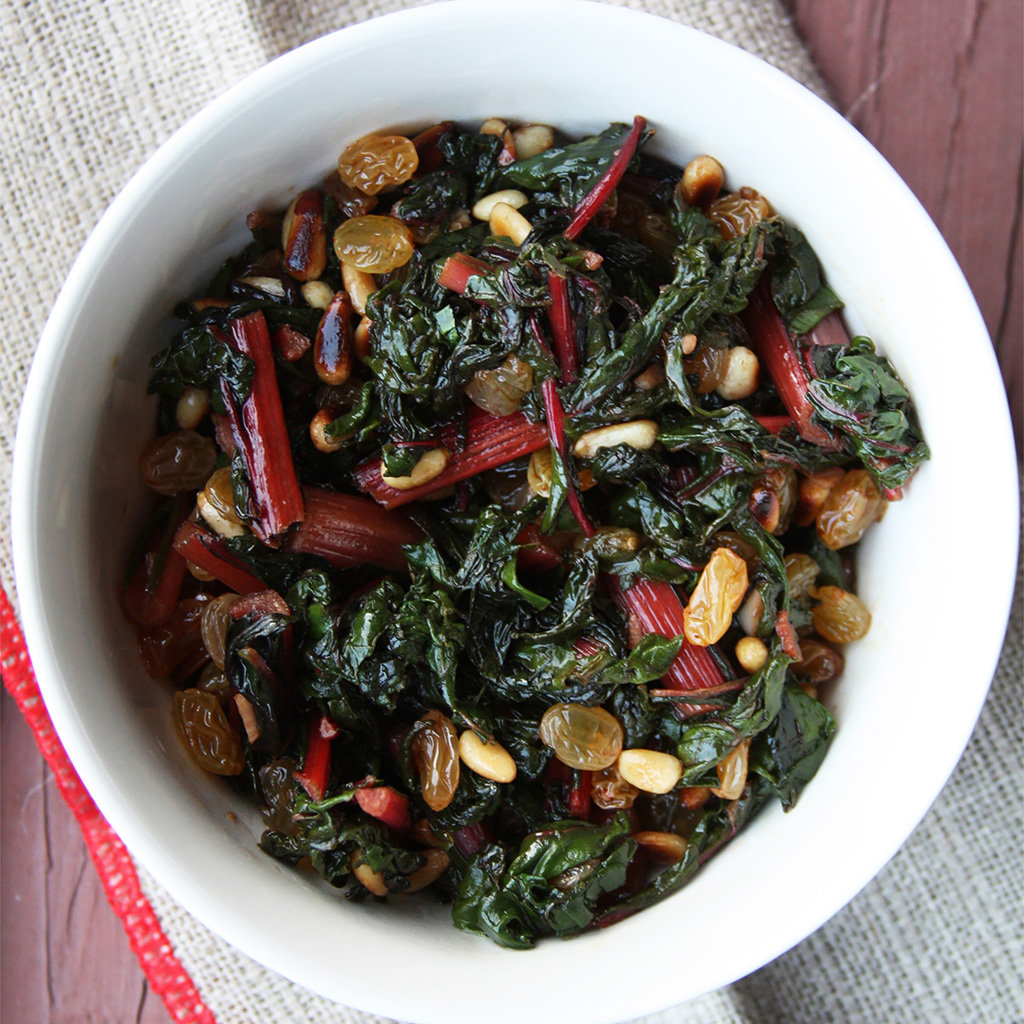
Sautéed Rainbow Chard with Golden Raisins and Pine Nuts
5 from 1 vote
The first time I had chard was a result of what I like to call grocery store wanderlust - wandering around a grocery store and trying not to buy every super colorful veggie that you see. The chard was so bright and colorful - pink, yellow, red, orange, green, and white - I just had to get it. Then of course I got home and didn't really know what to do with it, so I did some searching for ideas and ultimately came up with this recipe. It was spectacular. The chard itself is very flavorful and the colors make for a beautiful presentation. The golden raisins add a hint of sweetness and the balsamic vinegar gives a punch of acidity that balances everything out. Serve for lunch or as a side.
Sautéed Rainbow Chard with Golden Raisins and Pine Nuts
The first time I had chard was a result of what I like to call grocery store wanderlust – wandering around a grocery store and trying not to buy every super colorful veggie that you see. The chard was so bright and colorful – pink, yellow, red, orange, green, and white – I just had to get it. Then of course I got home and didn't really know what to do with it, so I did some searching for ideas and ultimately came up with this recipe. It was spectacular. The chard itself is very flavorful and the colors make for a beautiful presentation. The golden raisins add a hint of sweetness and the balsamic vinegar gives a punch of acidity that balances everything out. Serve for lunch or as a side.
Wash the chard, leaving some water clinging to the stalks and leaves. Cut the stalks into half inch pieces and keep separate from the leaves. Chop the leaves into about 3 inch long and 1-2 inch wide strips. Set aside.
In a large skillet over medium-high heat, toast the pine nuts, shaking the pan to brown evenly, 2-4 minutes. Remove the nuts from the pan and set aside.
In the same skillet, heat the olive oil over medium-high heat. Add the chard stalks and garlic and cook beginning to soften, about 4 minutes.
Add the chard leaves and raisins. Cover, reduce heat to medium-low, and cook until tender, 6-10 minutes stirring occasionally.
Take the lid off and pour out any excess water. Stir in the balsamic vinegar and pine nuts. Season with salt and pepper to taste and serve.
I’m a scientist by day and a foodie by night. Here you will find my favorite recipes, with a focus on low-carb, healthy meals. Visit the about page to learn more about me and the site.
Contains information related to marketing campaigns of the user. These are shared with Google AdWords / Google Ads when the Google Ads and Google Analytics accounts are linked together.
90 days
__utma
ID used to identify users and sessions
2 years after last activity
__utmt
Used to monitor number of Google Analytics server requests
10 minutes
__utmb
Used to distinguish new sessions and visits. This cookie is set when the GA.js javascript library is loaded and there is no existing __utmb cookie. The cookie is updated every time data is sent to the Google Analytics server.
30 minutes after last activity
__utmc
Used only with old Urchin versions of Google Analytics and not with GA.js. Was used to distinguish between new sessions and visits at the end of a session.
End of session (browser)
__utmz
Contains information about the traffic source or campaign that directed user to the website. The cookie is set when the GA.js javascript is loaded and updated when data is sent to the Google Anaytics server
6 months after last activity
__utmv
Contains custom information set by the web developer via the _setCustomVar method in Google Analytics. This cookie is updated every time new data is sent to the Google Analytics server.
2 years after last activity
__utmx
Used to determine whether a user is included in an A / B or Multivariate test.
18 months
_ga
ID used to identify users
2 years
_gali
Used by Google Analytics to determine which links on a page are being clicked
30 seconds
_ga_
ID used to identify users
2 years
_gid
ID used to identify users for 24 hours after last activity
24 hours
_gat
Used to monitor number of Google Analytics server requests when using Google Tag Manager